Wild Uplands at Penistone Hill Country Park, Haworth, West Yorkshire
Wild Uplands is a temporary public art and sculpture trail situated in Penistone Hill Country Park above Haworth in West Yorkshire. There are 4 large scale installations to be discovered across the country park which were created in response to the natural landscape in which they sit. Remaining in situ until 12th October, the sculptures owe their creation to nearby Bradford being the UK City of Culture for 2025. Thus, Wild Uplands at Penistone Hill Country Park is an exciting addition to this upland recreational area and a must if you visit Haworth this year.

Table of Contents
Penistone Hill Country Park
The country park covers an area that used to consist of three old quarries called Penistone, Dimples & West End. As a result, the landscape is rough, uneven, rocky and sandy with dips and hollows, some of which have formed small ponds. There are some areas where piles of stone have been left, hinting at its previous use, but largely the area has been clawed back by nature and is a glorious mix of grasses, heather, bracken, fern and a lot of Rosebay Willowherb.

Penistone Hill Country Park is a great place to go for a walk and is very popular with dog walkers, as there is no livestock on the hill and it has easy access from Haworth village and numerous free parking spots around the edges of the country park.

The Wild Uplands Sculptures
The four sculptures that currently sit on Penistone Hill are all very different.
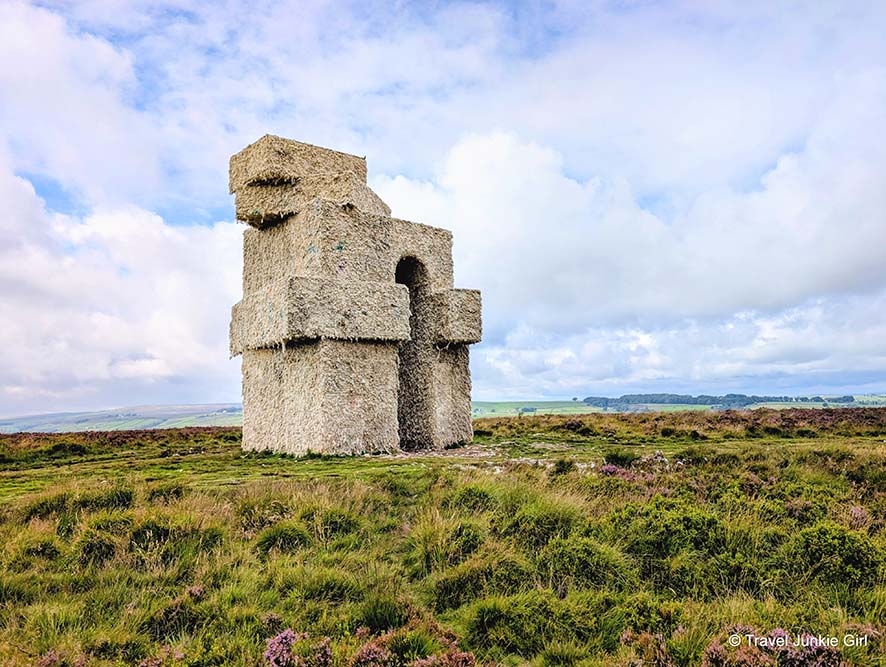
‘Tower’ by Steve Messam
I was particularly drawn to the huge 10-metre-tall tower made of different sized blocks, with an archway cut through and covered in sheep’s wool. Its monumental size and position on the very top of the hill with views in all directions adds to its impact.

In this work, the artist Steve Messam is referencing the building blocks that came from the quarries on Penistone Hill and their relationship to the building of Bradford. The raw sheep fleece used on the tower came from local sheep breeds and sourced from local farms, the inspiration for which came from the role of sheep in shaping the surrounding landscape and the importance of wool to Bradford’s industrial history.


‘Muamba Posy’ by Vanessa da Silva
This installation has an enviable position on Penistone Hill, on the eastern side overlooking the fabulous view up the valley towards Keighley and the hills and moors beyond. It’ll be the first sculpture you encounter if you walk up from Haworth.
I initially saw a combination of reproductive organs and plant life when I first saw Muamba Posy, so I was glad to read the accompanying information panel for more insight and to see that my brain was at least partially on the right track.

The three sculptures that form this installation draw inspiration from the long distant past when Penistone Hill was a tropical paradise, evoking the oversized plants and wildlife that once thrived here. They also take inspiration from the heather, bilberries, tomentils and damselflies that inhabit the landscape today. “The metallic shades of the sculptures are a nod to the metal-loving plants that thrive in the area’s mineral-rich soil, an often overlooked but important part of life on the hill.”
’99 Butterflies’ by Meherunnisa Asad Studio Lél
This installation was a surprise to come across as you round the crest of the hill that rises behind the previous sculpture (Muamba Posy) to look down on the small pool of water that permanently exists on Penistone Hill Country Park. The butterflies which look like they are created from marble slabs are scattered around the hollow in the ground surrounding the water pool, one of the many results of previous quarrying.

As they are low to the ground and in the hollow, this is the one Wild Uplands sculpture that is not visible from a distance. The artwork is intended to explore the experience of displacement, with each of the stone butterflies being a symbol of resilience and renewal.

‘The Children of Smokeless Fire’ by Monira Al Qadiri
This installation is situated on the northern slopes of Penistone Hill Country Park, with a glorious view looking west to Lower Laithe reservoir and the valley beyond.
The series of cut-out figures that make up this installation is a work of mystery and magic which takes its inspiration from the both the local Cottingley Fairies, which were created by two young girls in 1917 who lived in the Cottingley suburb of Bradford; and Djinns, which are supernatural beings from pre-Islamic Arabian and Islamic mythology, believed to be made from smokeless fire with free will. They are capable of both good and evil, and are able to take various forms, including human or animal.

By placing the Djinn cutouts into the nature of Penistone Hill Country Park, the artwork is intended to spark the same sense of wonder that the Cottingley Fairies did 100+ years ago.
I had not heard of the Cottingley Fairies, but was intrigued after reading up on them. The two girls created a series of photos with their artistically created fairy paper cutouts as a means of trying to prove the existence of fairies. I found it such an endearing story and was impressed to see that they came to the attention of Sir Arthur Conan Doyle who used them in an article he was commissioned to write about fairies. Click here to read more about it.
Earth & Sky
As part of the Wild Uplands project, there is an additional audio experience called Earth & Sky which you can download an app for to listen to as you walk round Penistone Hill Country Park. Earth & Sky uses state of the art geo-location technology so what you hear depends on the steps you take.
I cannot comment on this as my phone was not playing ball with me that day, so could not access this when I tried. It sounds like a great addition to the experience though.

Visitor Information for Penistone Hill Country Park
It only takes 10-15 mins to walk up onto Penistone Hill from the centre of Haworth where there are also numerous parking options.
There are several free car park areas all the way around the roads surrounding Penistone Hill. I parked in one on Cemetery Road.
There are no other facilities at Penistone Hill – the nearest public toilets can be found in Haworth’s Central Park and there are many eating options in the village too. I can highly recommend the food at The Old Sun Inn, at the northern end of Haworth Village. Handily, this pub also has its own car park too.

You should definitely explore Brontë country while you’re here. As well as the Brontë Parsonage Museum in Haworth, you can walk up to Brontë Waterfall and bridge which is a 2.5 mile walk from the centre of Haworth, (I did this while I was here) and then on to Top Withens, 1.25 miles beyond.
Top Withens is a ruined farmhouse with a lone tree high up on the moor which is associated with Emily Bronte’s novel Wuthering Heights. It is believed to have provided inspiration for the creation of the Earnshaw family home in the novel. Sadly, I did not have enough daylight hours to make it to Top Withins on this occasion, but I will next time I visit.

Wild Uplands is on until 12th October 2025, so there’s still a few weeks left to go see these artworks.
Get in Touch!
Have you visited Penistone Hills Country Park before? Did you go during Wild Uplands and if so, what did you think? Drop me a line in the comments below and let me know what you think. I’d love to hear from you.
If you’ve enjoyed reading this, please subscribe to my blog via email over on my profile page to receive notifications of when new posts go live. You can also sign up to receive my newsletter, or follow me through Bloglovin’. Then head on over to Facebook, Instagram or Twitter to keep up with all my travel related news. Hope to see you there.
Further Reading…
Travelling around Yorkshire? Have a gander at my other posts on God’s Own Country:
Walk to Lumb Hole Falls from Hebden Bridge / Explore the mystical site of Devil’s Arrows Standing Stones, near Boroughbridge / Visit Beningbrough Hall during Bluebell Season / See Brimham Rocks in the Snow / Explore Wakefield Cathedral and the city’s Rhubarb Festival / Walk the Ingleton Waterfalls Trail
PIN FOR LATER!

Share this:

4 COMMENTS
Leave A Comment
Lord Acuña | 19th Feb 26
Would love to visit the UK! <3
Tilly Jaye Horseman | 19th Feb 26
The UK certainly has a rich variety of landscapes to immerse yourself in! Hope you get here one day!
Loïs Cordelia | 28th Sep 25
What a stunning trail… and setting! Superb write-up, as ever. I didn’t know that’s where the fairy cutouts story came from.
Tilly Jaye Horseman | 12th Nov 25
Thanks Lois, I know – it was news to me too re the fairy cut-outs. I’m surprised I’d not heard of them considering my childhood was spent not far from Cottingly where my Grandparents lived. x